Feelings Wheel: find the word for what you feel

Start in the middle with a broad feeling, move outward to the precise one, then read what it means, what it often feels like, and stories from people who felt it. 91 feelings, free to print.

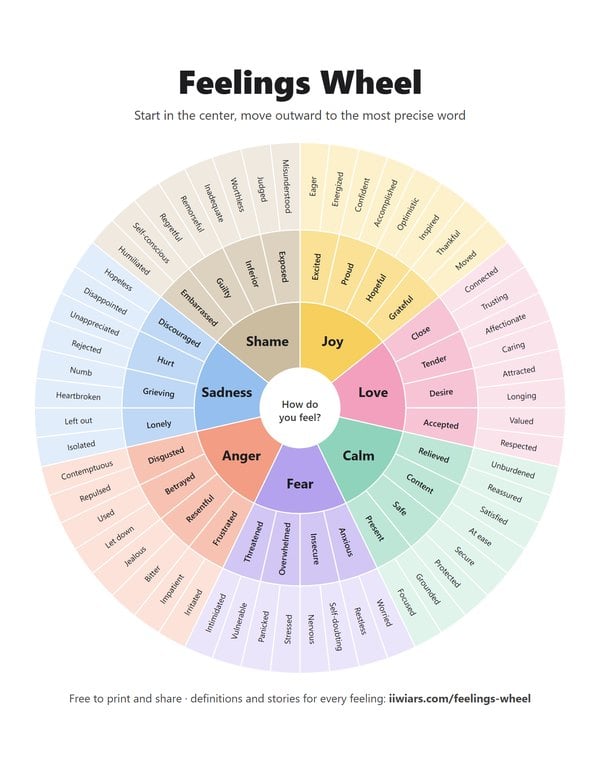
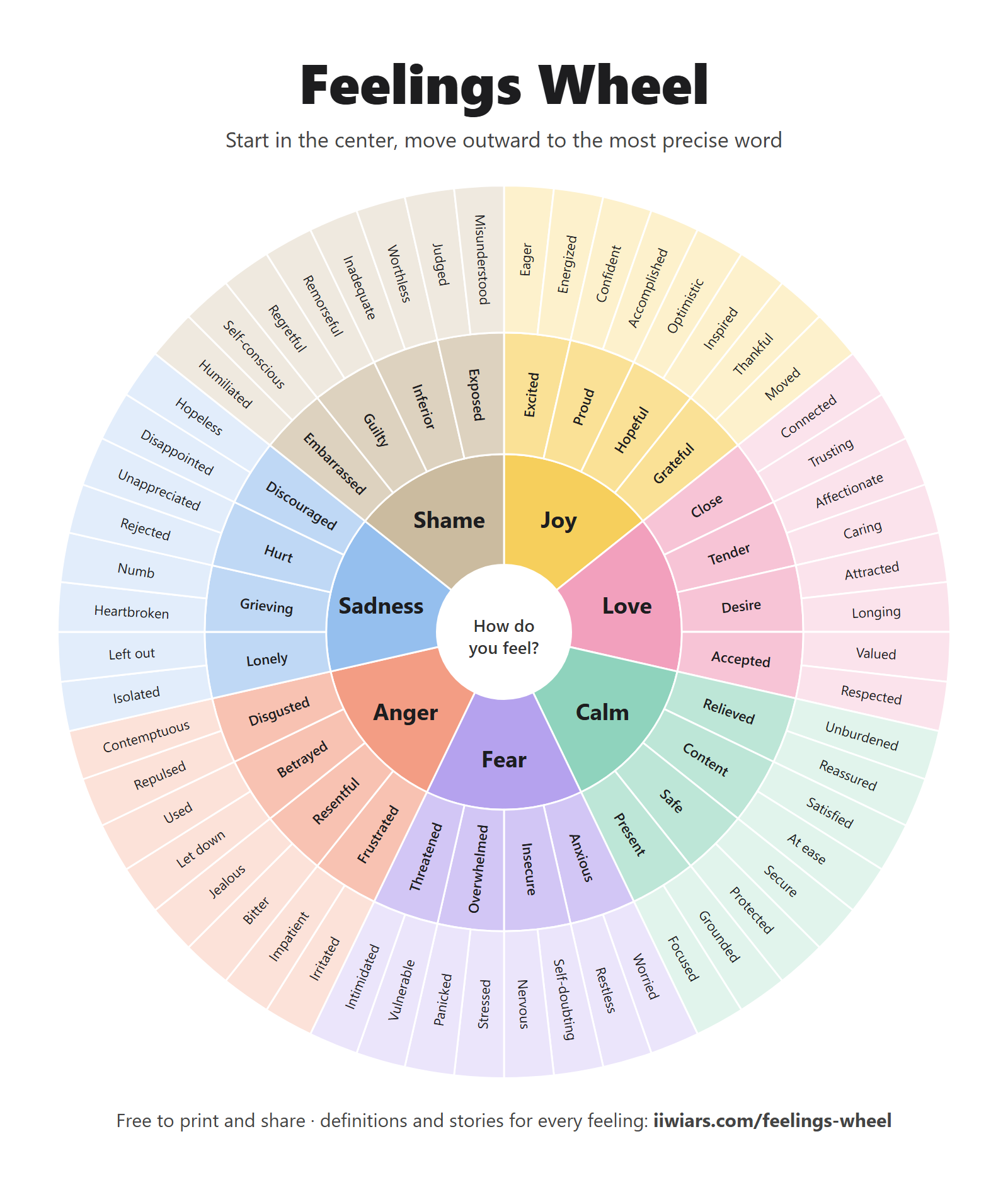
Feelings wheel: joy, love, calm, fear, anger, sadness, shame in the center, 28 nuances in the middle ring and 56 precise feelings on the outside. The full list is below the wheel. Joy Excited Eager Energized Proud Confident Accomplished Hopeful Optimistic Inspired Grateful Thankful Moved Love Close Connected Trusting Tender Affectionate Caring Desire Attracted Longing Accepted Valued Respected Calm Relieved Unburdened Reassured Content Satisfied At ease Safe Secure Protected Present Grounded Focused Fear Anxious Worried Restless Insecure Self-doubting Nervous Overwhelmed Stressed Panicked Threatened Vulnerable Intimidated Anger Frustrated Irritated Impatient Resentful Bitter Jealous Betrayed Let down Used Disgusted Repulsed Contemptuous Sadness Lonely Isolated Left out Grieving Heartbroken Numb Hurt Rejected Unappreciated Discouraged Disappointed Hopeless Shame Embarrassed Humiliated Self-conscious Guilty Regretful Remorseful Inferior Inadequate Worthless Exposed Judged Misunderstood How do you feel?
Start in the center with the broad feeling, move outward to the most precise word. Free to print and share: iiwiars.com/feelings-wheel

Print the feelings wheel or download the PDF

Two pages: the color wheel, then all 91 feelings as a list with the four steps to use it. Teachers, counselors, coaches and parents are welcome to print and share it for free, as long as the page address stays on it.

Download the PDF Image (PNG)

What is a feelings wheel?

A feelings wheel, also called an emotion wheel, is a circle of feeling words arranged from broad to precise. The center holds a few basic feelings; each ring outward splits them into more exact words. It exists because "I feel bad" or "I'm fine" rarely says much, and finding the exact word is often the first step to knowing what to do about a feeling.

Emotion wheels have been around since the 1980s: psychologist Robert Plutchik drew one with eight basic emotions in 1980, and therapist Gloria Willcox published her Feeling Wheel in 1982. The wheel on this page is our own. We chose seven core feelings, including love and shame, which come up constantly in the stories people share on IIWIARS, and calm, the feeling most of them are trying to get back to. Every definition was written for this page.

How to use the feelings wheel

  1. Start in the middle. Pick the broad feeling that is closest, even if it is only roughly right: joy, love, calm, fear, anger, sadness or shame.
  2. Move outward. Read the nuances next to it, then the precise words on the edge, and stop at the one that makes you think "yes, that's it."
  3. Check your body. Each feeling below comes with what it often feels like: a tight chest, a hot face, fidgety legs. If the description fits, you probably have the right word.
  4. Use the word. Say it to someone, write it in a journal, or tell the whole story on IIWIARS and read how other people handled the same feeling.

Two feelings at once is normal: relieved and guilty, angry and hurt. Pick both. And naming it helps: researchers who study "affect labeling" have found that putting a feeling into words tends to make it less intense.

All 91 feelings on the wheel, and what they mean

The full list of emotions on the wheel, grouped from the center outward, with stories from people who wrote about each feeling.

Joy

The lifting feelings that come when something goes well or matters to you.

Most often written about in Life Coach Issues Stories, Friendship Stories and Workplace Drama.

Excited

Joy pointed at something that is about to happen.

Eager Joy › Excited

Eager is wanting something to start, and wanting it now. It is excitement with impatience folded in, aimed at a plan, a person or a change you have already said yes to.

What it often feels like: Checking the date again, rehearsing the first day in your head, a restless energy that makes waiting harder than usual.

Stories about feeling eager:

Write about feeling eager More in Life Coach Issues Stories

Energized Joy › Excited

Energized is the feeling of having more fuel than you need. It usually follows something that matters to you, and it fades quickly when the thing that sparked it stops mattering.

What it often feels like: A body that wants to move, ideas arriving faster than you can write them down, tasks that look smaller than they did yesterday.

Stories about feeling energized:

Write about feeling energized More in Life Coach Issues Stories

Proud

Joy about something you did, or about who you are.

Confident Joy › Proud

Confident is trusting that you can handle what is in front of you. It is not the certainty of winning; it is the sense that losing would not break you.

What it often feels like: Standing a little straighter, speaking without rehearsing every sentence, not needing the room to agree before you act.

Stories about feeling confident:

Write about feeling confident More in Life Coach Issues Stories

Accomplished Joy › Proud

Accomplished is the satisfaction of having finished something that took real effort. It looks back at the work, not ahead at the next goal, and many people rush past it to the next thing.

What it often feels like: A deep breath out, wanting to tell someone, a quiet pride that can turn into "so what now?" surprisingly fast.

Stories about feeling accomplished:

Write about feeling accomplished More in Life Coach Issues Stories

Hopeful

Joy borrowed from a future that is not here yet.

Optimistic Joy › Hopeful

Optimistic is expecting things to turn out reasonably well. It leans on a forecast as much as a feeling, and it can sit right next to worry without canceling it.

What it often feels like: Making plans instead of backup plans, reading a silence as "busy" rather than "angry," giving a new start the benefit of the doubt.

Stories about feeling optimistic:

Write about feeling optimistic More in Life Coach Issues Stories

Inspired Joy › Hopeful

Inspired is being moved to act by something or someone outside you. It borrows energy from an example: a person, a story, a moment that shows you what is possible.

What it often feels like: A sudden "I could do that," wanting to start tonight rather than Monday, a picture of yourself that feels within reach.

Stories about feeling inspired:

Write about feeling inspired More in Life Coach Issues Stories

Grateful

Joy that turns toward whoever or whatever gave you something.

Thankful Joy › Grateful

Thankful is noticing that something good in your life came from outside you. It points at a giver, which is why it so often comes with the wish to say it out loud.

What it often feels like: Warmth toward a specific person, a lump in the throat when you think about what they did, the urge to send a message you keep postponing.

Stories about feeling thankful:

Write about feeling thankful More in Friendship Stories

Love

The pull toward other people: closeness, care, desire and the sense of being accepted.

Most often written about in Love Stories, Couple Stories and Dating Stories.

Close

Feeling near someone, and not only physically.

Connected Love › Close

Connected is feeling that someone understands you without a long explanation. It is the opposite of being surrounded by people and still alone, and people often notice it most when it is missing.

What it often feels like: Conversations that run past midnight, jokes nobody else gets, silences that are comfortable instead of awkward.

Stories about feeling connected:

Write about feeling connected More in Couple Stories

Tender

Gentle warmth that wants to look after someone.

Affectionate Love › Tender

Affectionate is warmth that wants to show itself, through touch, words or small attentions. People express it in very different amounts, which is a common source of misunderstanding between partners and in families.

What it often feels like: Wanting to hug, to sit closer, to send a heart for no reason; feeling a little hurt when it is not returned the same way.

Stories about feeling affectionate:

Write about feeling affectionate More in Couple Stories

Caring Love › Tender

Caring is wanting someone to be well and being ready to do something about it. When it goes one way for too long, it can turn into exhaustion and the question of how to stop caring.

What it often feels like: Worrying about how they slept, remembering their appointments, a pull to fix things that are not yours to fix.

Stories about feeling caring:

Write about feeling caring More in Couple Stories

Desire

Wanting someone: their presence, their attention, their touch.

Attracted Love › Desire

Attracted is being drawn to someone, physically, romantically or both. It often arrives before you know the person well, and it does not always match who you think you should want.

What it often feels like: Noticing exactly where they are in a room, replaying a short conversation, nerves that feel half pleasant and half terrifying.

Stories about feeling attracted:

Write about feeling attracted More in Love Stories

Accepted

Feeling welcome as you are, without having to earn it.

Valued Love › Accepted

Valued is feeling that what you bring matters to others and that they notice it. It is not about praise; it is about your effort being seen rather than taken for granted.

What it often feels like: Being asked for your opinion, a thank-you that names what you actually did, wanting to give more instead of less.

Stories about feeling valued:

Write about feeling valued More in Friendship Stories

Respected Love › Accepted

Respected is being treated as someone whose boundaries, time and choices count. You can be loved without being respected, and many stories here are about discovering that difference.

What it often feels like: Being listened to until you finish, a "no" that is accepted the first time, not having to defend every decision.

Stories about feeling respected:

Write about feeling respected More in Friendship Stories

Calm

The settled feelings that come when nothing needs fighting or fixing right now.

Most often written about in Health and Wellbeing Stories, Life Coach Issues Stories and Family Drama Stories.

Relieved

Calm that arrives when something you dreaded is over.

Unburdened Calm › Relieved

Unburdened is the lightness after putting down something you carried alone: a secret, a duty, a guilt. Many people only realize how heavy it was once it is gone.

What it often feels like: Sleeping through the night for the first time in weeks, shoulders dropping, a strange urge to laugh or cry right after telling someone.

Stories about feeling unburdened:

Write about feeling unburdened More in Family Drama Stories

Reassured Calm › Relieved

Reassured is fear easing because someone or something answered it. It works best when it comes from facts or from a person you trust, and wears off fast when it does not.

What it often feels like: Breathing normally again, the story in your head getting quieter, sometimes needing to hear it one more time.

Stories about feeling reassured:

Write about feeling reassured More in Family Drama Stories

Content

Calm that says: this is enough, for now.

Satisfied Calm › Content

Satisfied is having what you wanted from a situation, without reaching for more. It is quieter than joy and easy to overlook.

What it often feels like: Not scrolling for something better, a meal or a day that feels complete, no list running in the back of your mind.

Stories about feeling satisfied:

Write about feeling satisfied More in Life Coach Issues Stories

Safe

Calm that comes from knowing nothing is about to hurt you.

Secure Calm › Safe

Secure is trusting that a relationship or a situation will hold, even when it is tested. In relationships it means one unanswered message is just a message, not a verdict.

What it often feels like: Not needing constant proof, disagreeing without fearing the end, being able to be apart without spiraling.

Stories about feeling secure:

Write about feeling secure More in Family Drama Stories

Protected Calm › Safe

Protected is knowing someone or something stands between you and harm. It can come from family, friends, a partner or a place, and it can be built later in life too.

What it often feels like: Being able to sleep without listening for noises, saying what happened without fearing the reaction, a place you can go back to.

Stories about feeling protected:

Write about feeling protected More in Family Drama Stories

Present

Calm that lives in this moment instead of the next one.

Focused Calm › Present

Focused is having your attention where you want it, for as long as you need it. It is fragile: stress, worry and tiredness are the first things that break it.

What it often feels like: Losing track of time, the phone forgotten face down, distractions sliding past instead of pulling you in.

Stories about feeling focused:

Write about feeling focused More in Health and Wellbeing Stories

Fear

The alarm feelings that get you ready for a threat, real or imagined, now or later.

Most often written about in Health and Wellbeing Stories, Workplace Drama and School Stories.

Anxious

Fear about what might happen, stretched over time.

Worried Fear › Anxious

Worried is thinking again and again about something that could go wrong. It feels like preparing, but it rarely changes the outcome, which is part of what makes it so tiring.

What it often feels like: The same question looping at night, checking your phone for news, a knot in the stomach that loosens only when you get an answer.

Stories about feeling worried:

Write about feeling worried More in Health and Wellbeing Stories

Insecure

Fear aimed at yourself: am I enough, will I get it right?

Self-doubting Fear › Insecure

Self-doubting is not trusting your own judgment, even when you have good reasons to. It makes you ask others to confirm what you already know.

What it often feels like: Rewriting a message five times, asking "is it just me?", backing down from an opinion as soon as someone disagrees.

Stories about feeling self-doubting:

Write about feeling self-doubting More in Life Coach Issues Stories

Overwhelmed

Fear that comes from having more than you can handle.

Stressed Fear › Overwhelmed

Stressed is being under more pressure than you have room for. A little of it can sharpen you; a lot of it for a long time wears down sleep, mood and health.

What it often feels like: A tight jaw, a short temper, lying awake making lists, sometimes headaches or a stomach that will not settle.

Stories about feeling stressed:

Write about feeling stressed More in Workplace Drama

Panicked Fear › Overwhelmed

Panicked is fear that takes over all at once, so strongly that it is hard to think. It usually eases within minutes, but in the moment it can feel like something is seriously wrong; if it is new or comes with chest pain, get checked by a doctor.

What it often feels like: A racing heart, trouble breathing, dizziness, shaking, an urgent need to get out of wherever you are.

Stories about feeling panicked:

Write about feeling panicked More in Workplace Drama

Threatened

Fear of a person or situation that could hurt you. If you are not safe right now, contact local emergency services.

Vulnerable Fear › Threatened

Vulnerable is feeling exposed to being hurt, usually because you let someone see something real. It is the price of closeness, and a dismissive answer can make it feel like a mistake.

What it often feels like: Regretting what you shared a minute after sharing it, watching the other person's face closely, wanting to take it back.

Stories about feeling vulnerable:

Write about feeling vulnerable More in Family Drama Stories

Intimidated Fear › Threatened

Intimidated is feeling smaller around a person, group or situation that seems stronger than you. It makes you go quiet even when you have every right to speak.

What it often feels like: Rehearsing what to say and then not saying it, avoiding someone in the hallway, feeling like the new kid at any age.

Stories about feeling intimidated:

Write about feeling intimidated More in Family Drama Stories

Anger

The push-back feelings that rise when something seems unfair, blocked or wrong.

Most often written about in Family Drama Stories, Workplace Drama and Friendship Stories.

Frustrated

Anger at something that keeps getting in your way.

Resentful

Anger that was stored instead of spoken.

Bitter Anger › Resentful

Bitter is old anger that has settled and soured. It usually comes from a hurt that was never acknowledged, and it colors new moments with old ones.

What it often feels like: Replaying what happened years ago, sarcasm that slips out, struggling to be happy for the person involved.

Stories about feeling bitter:

Write about feeling bitter More in Family Drama Stories

Jealous Anger › Resentful

Jealous is the fear of losing someone to another person, often mixed with anger. Unlike envy, which wants what someone else has, jealousy guards something you feel is yours.

What it often feels like: Checking who liked their post, a hot flash when a name comes up, needing reassurance more than usual.

Stories about feeling jealous:

Write about feeling jealous More in Family Drama Stories

Betrayed

Anger at someone you counted on.

Disgusted

Anger mixed with rejection: get this away from me.

Repulsed Anger › Disgusted

Repulsed is a strong urge to pull away from something or someone, often felt in the body before the mind explains it. It can also be turned inward, toward your own body or actions.

What it often feels like: A wrinkled nose, a turned stomach, stepping back, not wanting to be touched.

Stories about feeling repulsed:

Write about feeling repulsed More in Friendship Stories

Contemptuous Anger › Disgusted

Contemptuous is looking down on someone as beneath respect. In close relationships it is one of the most damaging feelings to receive, because it attacks the person rather than the problem.

What it often feels like: Eye-rolling, a mocking tone, feeling superior, or, on the receiving end, feeling small in your own home.

Stories about feeling contemptuous:

Write about feeling contemptuous More in Friendship Stories

Sadness

The heavy feelings that follow a loss, a distance, or something that did not happen.

Most often written about in Friendship Stories, Love Stories and Health and Wellbeing Stories.

Lonely

Sadness about missing connection.

Grieving

Sadness after losing someone or something that mattered.

Heartbroken Sadness › Grieving

Heartbroken is the deep pain of losing a love, through a death, a breakup, a betrayal or a friendship ending. It comes in waves, and the waves get further apart rather than stopping all at once.

What it often feels like: A physical ache in the chest, no appetite, songs you cannot listen to anymore, checking their profile even though it hurts.

Stories about feeling heartbroken:

Write about feeling heartbroken More in Love Stories

Numb Sadness › Grieving

Numb is feeling nothing where you would expect to feel a lot. It is often the mind protecting itself after too much pain or pressure; it can lift as things ease, and if it lasts, it is worth talking to someone.

What it often feels like: Wanting to cry and not being able to, going through the motions, watching your own life a little from the outside.

If this has lasted for weeks, or comes with thoughts of not wanting to be here, please talk to someone today: free crisis lines by country.

Stories about feeling numb:

Write about feeling numb More in Love Stories

Hurt

Sadness caused by what someone did, or did not do.

Unappreciated Sadness › Hurt

Unappreciated is giving a lot and having it go unnoticed. Over time it can turn into resentment, or into the decision to stop giving.

What it often feels like: Keeping score without wanting to, a thank-you that never comes, thinking "they would notice if I stopped."

Stories about feeling unappreciated:

Write about feeling unappreciated More in Friendship Stories

Discouraged

Sadness about effort that did not pay off.

Disappointed Sadness › Discouraged

Disappointed is the gap between what you hoped for and what happened. It can be aimed at others or at yourself, and it is often sharper when you let yourself hope.

What it often feels like: A sinking feeling, a quiet "oh," pretending it is fine, lowering your expectations for next time.

Stories about feeling disappointed:

Write about feeling disappointed More in Workplace Drama

Hopeless Sadness › Discouraged

Hopeless is believing that nothing you do will change things. It is one of the heaviest feelings on the wheel, and when it lasts or comes with thoughts of not wanting to live, it is a reason to talk to someone today.

What it often feels like: No energy to try, the future looking flat or empty, "what's the point?" coming back again and again.

If this has lasted for weeks, or comes with thoughts of not wanting to be here, please talk to someone today: free crisis lines by country.

Stories about feeling hopeless:

Write about feeling hopeless More in Workplace Drama

Shame

The painful feelings about yourself, in the eyes of others or in your own.

Most often written about in School Stories, Family Drama Stories and Life Coach Issues Stories.

Embarrassed

Shame over a moment other people saw.

Humiliated Shame › Embarrassed

Humiliated is being made to look small in front of others, sometimes on purpose. It cuts deeper than embarrassment because it feels like your worth, not just a moment, was put on display.

What it often feels like: A burning face, wanting the floor to swallow you, replaying the scene long after everyone else forgot it.

Stories about feeling humiliated:

Write about feeling humiliated More in School Stories

Guilty

The sting of having done something wrong, rather than being something wrong.

Regretful Shame › Guilty

Regretful is wishing you had chosen differently. It looks back at a decision, and it is often strongest about the things you did not do or say.

What it often feels like: "What if" on repeat, imagining the other version of events, wanting a second chance.

Stories about feeling regretful:

Write about feeling regretful More in Couple Stories

Remorseful Shame › Guilty

Remorseful is feeling sorry for harm you caused and wanting to make it right. Unlike vague guilt, it points at something specific you can repair or apologize for.

What it often feels like: Not being able to enjoy anything until you have apologized, rehearsing what to say, checking whether the other person is okay.

Stories about feeling remorseful:

Write about feeling remorseful More in Couple Stories

Inferior

Shame about who you think you are, compared with others.

Inadequate Shame › Inferior

Inadequate is feeling that you are not enough for what is expected of you. It survives evidence to the contrary: even a good grade or a promotion can feel like a mistake someone will soon discover.

What it often feels like: Comparing yourself with everyone, waiting to be found out, discounting every success as luck.

Stories about feeling inadequate:

Write about feeling inadequate More in Life Coach Issues Stories

Worthless Shame › Inferior

Worthless is believing you have no value at all, not just that you failed at something. It is a judgment about your whole self, and it is almost always harsher than anything others would say about you.

What it often feels like: Brushing off every compliment, feeling like a burden, feeling like you take up space you do not deserve.

If this has lasted for weeks, or comes with thoughts of not wanting to be here, please talk to someone today: free crisis lines by country.

Stories about feeling worthless:

Write about feeling worthless More in Life Coach Issues Stories

Exposed

Shame of being seen, judged or misread.

Misunderstood Shame › Exposed

Misunderstood is being seen as someone you are not, especially by the people closest to you. It can make you stop trying to explain yourself at all.

What it often feels like: Saying one thing and hearing it repeated as another, feeling like the black sheep, rehearsing explanations no one asked for.

Stories about feeling misunderstood:

Write about feeling misunderstood More in Family Drama Stories

Questions about the feelings wheel

What are the core feelings on this wheel?

Seven: joy, love, calm, fear, anger, sadness and shame. Each one opens onto four nuances and then eight precise feelings, 91 words in all.

Is this the Plutchik wheel or the Gloria Willcox Feeling Wheel?

Neither. Both inspired a long line of emotion wheels, but this list is our own. We put love and shame in the center because they come up constantly in the stories shared on IIWIARS, and calm because it is the feeling most authors are trying to get back to. We wrote every definition ourselves.

Can I print it for my class, my clients or my family?

Yes. The PDF is free to print and share for personal, classroom, counseling and coaching use, as long as the page address stays on it. You do not need to ask or sign up.

Is the feelings wheel for kids or for adults?

The words are chosen for teens and adults. Younger children usually do better with the seven feelings in the middle, then one ring at a time.

Is the feelings wheel a test?

No. It only helps you find a word; it does not say what is going on or what to do about it. If a feeling has lasted for weeks or is getting in the way of sleep, school or work, talking to a doctor or a counselor is a good next step.

Where to go next

  • Why am I so emotional? Crying easily, feeling everything too much, or not being able to cry: what people asked and what the replies found.
  • Am I overreacting? You know what you feel; this checks whether the reaction fits what happened.
  • All topics: guides, quizzes and the categories where people share their stories.